

Commentary
Although the IAA often differs from the IRA, European policymakers can still take note of the U.S. act’s shortcomings.
Milo McBride
{
  "authors": [
    "Pavlo Zvenyhorodskyi"
  ],
  "type": "commentary",
  "centerAffiliationAll": "dc",
  "centers": [
    "Carnegie Endowment for International Peace"
  ],
  "englishNewsletterAll": "ctw",
  "nonEnglishNewsletterAll": "",
  "programAffiliation": "TIA",
  "programs": [
    "Technology and International Affairs"
  ],
  "regions": [
    "Europe"
  ],
  "topics": [
    "Technology",
    "Economy",
    "EU",
    "Trade",
    "AI"
  ]
}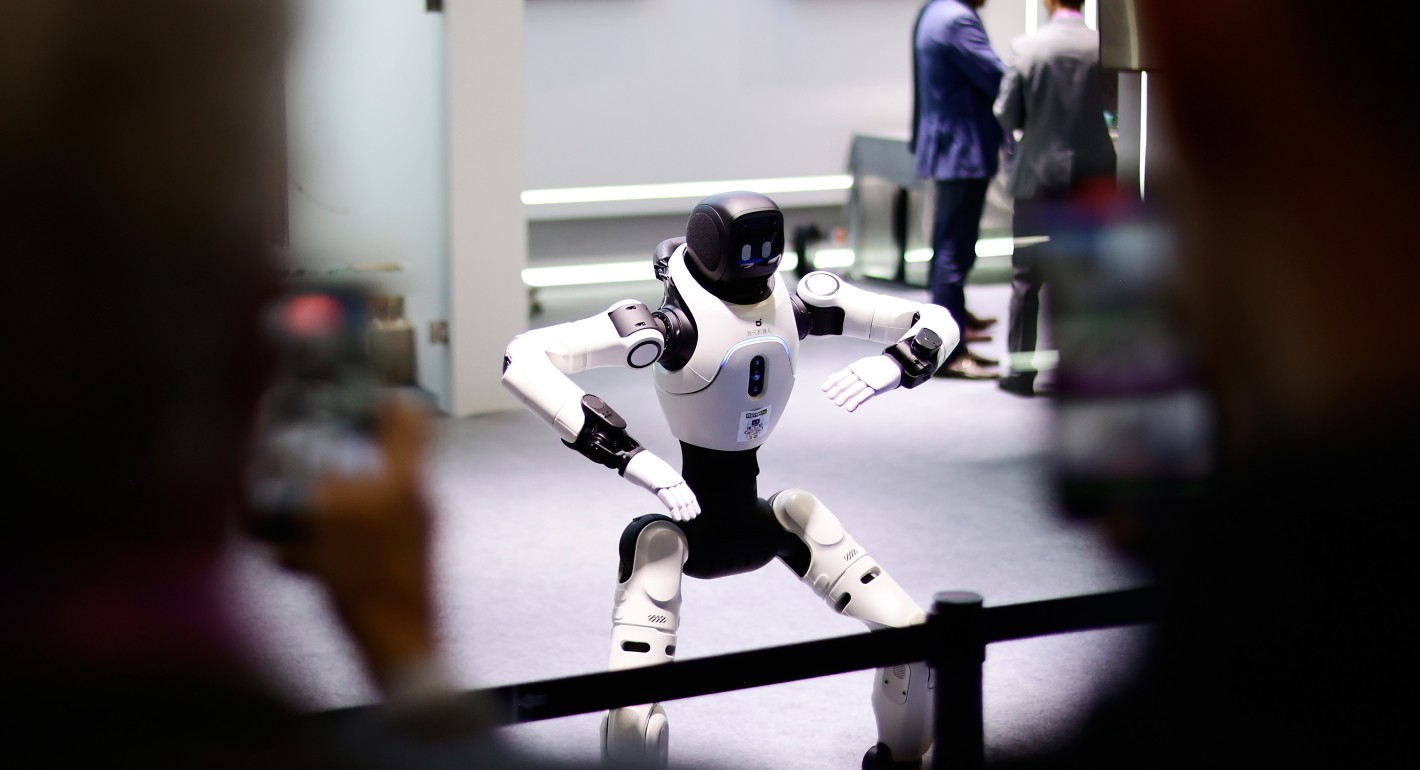
A compact humanoid robot performs a synchronized dance routine during the Mobile World Congress in Barcelona, Spain, on March 5, 2026. (Photo by Joan Cros/NurPhoto via Getty Images)
The continent needs to improve conditions for production of complete AI robotic systems and preserve its edge in hardware.
When German Chancellor Friedrich Merz traveled to China at the end of last month, he visited Unitree Robotics, one of the country’s leading developers of general-purpose robotics—autonomous systems powered by advanced AI models. Surrounded by his delegation, Merz watched a spectacular martial-arts performance by the company’s humanoids, who were backflipping and twirling nunchucks with striking dexterity.
Merz was impressed and fascinated, but he should have been scared. China’s robotics advances have kicked off a global race in what will likely be a transformative technology, and Europe is far behind. Unless European leaders realize the stakes and make big moves quickly, they will risk new structural dependencies that would further weaken Europe’s sovereignty and security.
General-purpose robotics is still under development, with just over 13,000 units sold globally last year. But early models are already being piloted on warehouse floors and in retail stores. While the pace of progress is anyone’s guess, the most bullish forecasters project that annual shipments of AI robots could reach 10 million units within the next decade. Once mature, these systems could automate factories and construction sites, become indispensable assistants in our households and nursing homes, and even be deployed on the battlefield.
Countries that dominate exports of general-purpose robots could weaponize others’ dependence on this critical technology. They could install backdoors and kill switches in their robots to monitor or shut down operations across their customers’ economies. They would also be able to control who gains access to these systems, restricting exports to countries that are not geopolitically aligned with them. And while Europe watches, others are racing to secure this leverage.
This may sound like science fiction—but so did AI just a few years ago, and now Europe is scrambling for relevance in an increasingly AI-powered world. Today, Europe cannot afford to make the same mistake with general-purpose robotics.
China is emerging as a frontrunner. Beijing has made the development of embodied AI—artificial intelligence embedded in physical machines—a strategic priority, with general-purpose robotics at the core of this push. The Chinese government has established multiple support mechanisms for domestic producers. This support has helped several Chinese companies, including Unitree, to achieve significant technological breakthroughs and to comfortably lead global sales of general-purpose robots.
The United States is another major contender, with rapidly advancing capabilities in robotics and a powerful chokepoint position in the value chain. Several American firms, including Tesla and Figure AI, have developed complete systems with leading technical capabilities. In parallel, companies such as NVIDIA have become almost indispensable providers of AI processors—robots’ “brains.”
Meanwhile, Europe finds itself trailing its competitors in the production of complete general-purpose systems, and its position in the global value chain risks deteriorating. The bloc has very few manufacturers capable of competing with their Chinese and American counterparts in technical capabilities and value-for-price ratio. This scarcity of domestic options is already pushing European businesses to look abroad. Airbus, Europe’s flagship aerospace manufacturer, recently signed a deal with China’s UBTech to deploy the firm’s humanoids on its production lines.
Europe’s only clear advantage lies in hardware. The continent is a world-leading provider of key hardware components for robotics, particularly actuators—often described as the “muscles” that enable robots to move. This strength rests on Europe’s, and especially Germany’s, decades-long experience in industrial robotics manufacturing. Yet even this advantage is shrinking. In recent years, Chinese firms have acquired several leading German robotics firms, such as KUKA, to bolster their capabilities in advanced hardware—and are now gradually closing the gap.
If these trends persist, the EU risks a double whammy. First, it may become heavily dependent on Chinese and American suppliers of general-purpose robotics, including in critical sectors such as infrastructure. Second, it may lose whatever leverage it still holds as China pulls ahead in key hardware components. At a moment when the EU’s structural dependencies—whether in energy, trade, or rare earths—are increasingly used against it, this would be a deeply troubling outcome.
What should Europe do? The first step is obvious: Recognize the seriousness of the problem. Europe must admit it is risking irrelevance in yet another transformative technology, and its security and sovereignty could be on the line.
However, pursuing full self-sufficiency across all applications would be costly and unrealistic given the gap Europe would need to close and the fiscal pressures facing the continent. Instead, European policymakers should align around a more achievable goal that prioritizes core European interests.
One idea would be to ensure Europe has sufficient capacity to produce domestic alternatives for the most strategically sensitive use cases, such as government operations or critical logistics. Although these systems may be less cost-competitive than imported alternatives, they would be insulated from external manipulation and shield critical sector operations from disruption if foreign producers were to suspend supplies.
Achieving even this modest goal will be easier said than done. Governments have limited leverage over private technology development, while inertia, infighting, and limited resources constrain both EU-level and national action.
A guiding principle for the European Commission and member states should be reducing structural constraints on industry, rather than granting one-off benefits to favored companies. Key structural constraints include inadequate access to private capital and rigid labor rules. Left unresolved, these will force companies to relocate abroad.
Europe should also safeguard its current chokepoint advantage in the global general-purpose robotics value chain. Member states should apply heightened scrutiny to foreign acquisitions of firms producing critical hardware components in sectors where Europe still holds a competitive edge. This would reduce the risk of sensitive technology transfers and make it more difficult for competitors to substitute European components in their robotics systems, thereby preserving an important source of leverage for Europe.
But foreign acquisitions are often a response to genuine commercial challenges, such as undercapitalization. Unless these deeper issues are addressed, investment screening will only delay the inevitable.
The global race in general-purpose robotics is underway. Whether Europe remains a passive observer—envying others’ successes—or emerges as a serious contender safeguarding its strategic interests depends on what it decides to do next.
The author would like to thank Jon Bateman, Scott Singer, and Anton Leicht for their helpful feedback on previous drafts. The writer acknowledges the use of LLM tools for preliminary desk research and clarificatory editing.

Pavlo Zvenyhorodskyi
Research Analyst, Technology and International Affairs
Although the IAA often differs from the IRA, European policymakers can still take note of the U.S. act’s shortcomings.

Milo McBride
The EU is structurally incapable of reacting to today’s foreign policy crises. The union must fold the EEAS into the European Commission and create a security council better prepared to take action on the global stage.

Stefan Lehne
The future trajectory of the U.S.-Iran war remains uncertain, but its impact on global energy trade flows and ties will be far-reaching. Moscow is likely to become a key beneficiary of these changes; the crisis in the Gulf also strengthens Russia’s hand in its relationships with China and India, where advantages might prove more durable.

Sergey Vakulenko
The Kremlin expects to not only profit from rising fertilizer prices but also exact revenge for the collapse of the 2023 grain deal.

Alexandra Prokopenko

India and the United States are close to concluding a Reciprocal Defense Procurement Agreement (RDPA) that will allow firms from the two countries to sell to each other’s defense establishments more easily. While this may not remedy the specific grievances both sides may have regarding larger bilateral issues, an RDPA could restore some momentum, following the trade deal announcement.

Konark Bhandari