

Commentary
Yezid Sayigh
{
  "authors": [
    "Yezid Sayigh"
  ],
  "type": "commentary",
  "blog": "Diwan",
  "centerAffiliationAll": "",
  "centers": [
    "Carnegie Endowment for International Peace",
    "Malcolm H. Kerr Carnegie Middle East Center"
  ],
  "englishNewsletterAll": "",
  "nonEnglishNewsletterAll": "",
  "primaryCenter": "Malcolm H. Kerr Carnegie Middle East Center",
  "programAffiliation": "",
  "regions": [
    "Lebanon",
    "Israel",
    "United States",
    "Iran"
  ]
}
Source: Getty
At heart, to impose unconditional surrender on Hezbollah and uproot the party among its coreligionists.
Israel is repeating parts of the military playbook it used against Hezbollah in 2024, but its strategy is different this time. It was evident, even before Hezbollah fired a handful of rockets toward Haifa in northern Israel in the early hours of March 1, that the Israeli political leadership and military command had been looking for a reason to resume the war ever since the lopsided ceasefire agreement of November 2024. This begs the question: What does Israel now seek to achieve—and how?
One thing is certain: Israel’s goals in Lebanon cannot be measured today against what it sought in 2024. At the time, it remained constrained by Iranian strategic deterrence—not so much due to the effectiveness of the latter, but because the opposition of the Biden administration to all-out war between Israel and Iran acted as a crucial restraining factor. The context is drastically different this time around, thanks to the full-throated engagement of the administration of President Donald Trump in a war to destroy Iran’s principal strategic capabilities—its ballistic missile and drone production capability, and its nuclear program. Trump might diverge from Israeli Prime Minister Benjamin Netanyahu in preferring to see a more compliant regime emerge in Iran than a completely new one, but Netanyahu is going all-out for regime collapse.
Everything in Israel’s military campaign against Iran points to this goal. Reports that its assassination campaign has extended beyond military and security officials to known anti-regime leftists suggest that it also seeks to remove potential democratic opposition from filling even part of the void that may be left by the clerical regime. Israeli military commanders have evidently planned to trigger cascading effects in Iran, anticipating these would culminate in a complete rewriting of the country’s political system—with state failure and widespread civil strife as acceptable, if not desirable, collateral damage.
There is absolutely no reason to expect Israel’s goals in Lebanon to be any less ambitious and far-reaching. A great deal more than the disarmament of Hezbollah is on the Israeli agenda. The widespread assumption that Israel intends to impose a formal peace treaty on Lebanon is plausible, but this may not be its foremost goal.
Rather than seek the restriction of Hezbollah’s activities “to the political sphere,” as the Lebanese government announced when banning the party’s military activities on March 2, a more plausible interpretation of Israel’s principal goal is to engineer Hezbollah’s complete outlawing and dissolution. Historical analogies should never be taken too far, but one that comes to mind is the Japanese surrender in World War II. The country had not been fully defeated on the battlefield when the atom bombs were dropped on Hiroshima and Nagasaki; indeed, some Japanese officers believed the army retained enough strength to negotiate “peace with honor,” and even mounted a short-lived coup attempt to pursue their preferred approach. It seems likely that Israel wants something similar with Hezbollah to what the Americans sought with Japan: unconditional surrender.
Consequently, Israel seeks more than simply to compel the Lebanese government to move beyond declaratory policy to actively implement its ban on Hezbollah’s weapons. The government’s ability to comply is in question, above all due to concerns over the cohesion of the Lebanese army if it is ordered to undertake disarmament by force. However, the radical shifts in both the regional strategic context and the domestic political balance in Lebanon offer Israel a unique opportunity to ram through its objectives in full.
That said, Israel cannot ensure the full disarmament of Hezbollah, or its political suppression, alone. Again, the past offers instructive lessons. The futile effort by the Lebanese National Movement—the coalition of leftist and nationalist parties backed by the Palestine Liberation Organization (PLO)—to “isolate” the Lebanese Kataeb Party during the 1975–1976 civil war confirms this. So, no matter how efficiently lethal Israel’s firepower is, it cannot complete the job without occupying major tracts of Lebanon beyond the south, something that would raise the risks and long-term costs for Israel. A complementing Lebanese effort is necessary, hence the effort to force the Lebanese government’s hand one way or the other, in part by dismantling the “sea” in which Hezbollah lives.
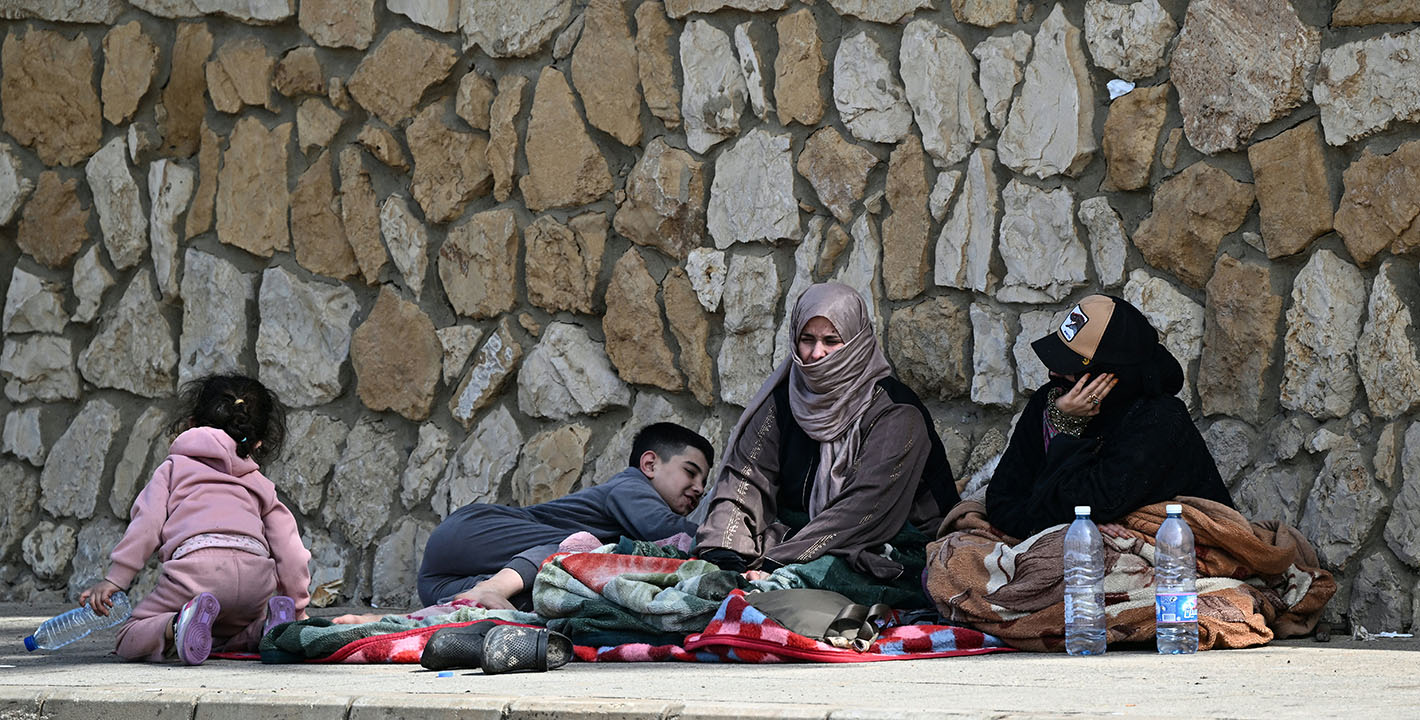
The orders to evacuate entire swathes of south Lebanon and the southern suburbs of Beirut, along with threats to create a deep buffer zone along the common border and the intimation that Israel will carpet bomb Hezbollah’s southern suburbs stronghold, all serve this purpose. None of the elements of this military strategy is new, of course. Israel deliberately targeted the civilian population of south Lebanon under its “active defense” policy of the late 1960s in order to drive massive refugee flows toward Beirut, with the aim of generating pressure on the central government to cancel the 1969 Cairo Agreement with the PLO, which legitimized the latter’s presence in Lebanon, and forcibly eliminate the emerging Palestinian guerrilla sanctuary in the south. Mass evacuation orders also accompanied the 2024 war on Hezbollah, but there was a more immediate military purpose then: to decapitate the party, decimate its core cadre, and destroy its military stockpiles and infrastructure.
Applying the same tactics under conditions of unrestrained Israeli power points to fundamentally different aims and outcomes. This is not to deny that Israel has immediate military objectives and will seek to extract tactical advantages every step of the way, or to ignore the possibility of its war objectives evolving as it goes along. Any ground incursion could harden into a long-term presence, for example, not as a prelude to annexation as some believe, but more likely to reap further gains in the form of a peace treaty and normalization with Lebanon. But Israel’s ratcheting up of military pressure necessarily has a political purpose first and foremost: to drive the political isolation of Hezbollah, and crucially its social undermining, as a prelude to its uprooting among the Shiite community, and even its own core constituency.

Senior Fellow, Malcolm H. Kerr Carnegie Middle East Center
Yezid Sayigh is a senior fellow at the Malcolm H. Kerr Carnegie Middle East Center in Beirut, where he leads the program on Civil-Military Relations in Arab States (CMRAS). His work focuses on the comparative political and economic roles of Arab armed forces, the impact of war on states and societies, the politics of postconflict reconstruction and security sector transformation in Arab transitions, and authoritarian resurgence.
Recent Work
Yezid Sayigh
Yezid Sayigh
Carnegie does not take institutional positions on public policy issues; the views represented herein are those of the author(s) and do not necessarily reflect the views of Carnegie, its staff, or its trustees.
As Iran defends its interests in the region and its regime’s survival, it may push Hezbollah into the abyss.

Michael Young
Because of this, the costs and risks of an attack merit far more public scrutiny than they are receiving.

Nicole Grajewski

The organization is under U.S. sanctions, caught between a need to change and a refusal to do so.
Mohamad Fawaz

A coalition of states is seeking to avert a U.S. attack, and Israel is in the forefront of their mind.
Michael Young
Implementing Phase 2 of Trump’s plan for the territory only makes sense if all in Phase 1 is implemented.
Yezid Sayigh